
Doctors Abroad · Approbation, FSP and KP
Work as a doctor in Germany with a clear plan
If you trained as a doctor outside Germany, the path to Approbation can feel complex: documents, German language, the responsible federal-state authority, FSP, KP, Berufserlaubnis and realistic timing. This page gives you a publishable starting point and shows how MedizinWissen can support your preparation.
Current status · June 2026
The 2026 reform makes early KP planning more important for many non-EU doctors.
The German Bundestag passed the law to accelerate recognition procedures for foreign healthcare qualifications on 26 March 2026, and the Bundesrat approved it on 8 May 2026. The new rules are scheduled to apply from 1 November 2026. Official information describes a more digital and more standardized process.
Direct KP becomes the standard route
For doctors from third countries, the direct knowledge test is planned to become the standard recognition procedure. The document-based equivalence assessment remains possible, but no longer as the normal route for many applicants.
FSP stays central
The Fachsprachenprüfung remains an important gate. In practice, international doctors should treat medical German and clinical communication as a core part of the pathway, not as a small administrative step.
Capacity can become the bottleneck
If more applicants move into the KP route, waiting times and exam capacity may become even more important. Preparing early can reduce wasted time before Approbation and specialty training.
Recognition roadmap
The process is not one form. It is a sequence of decisions.
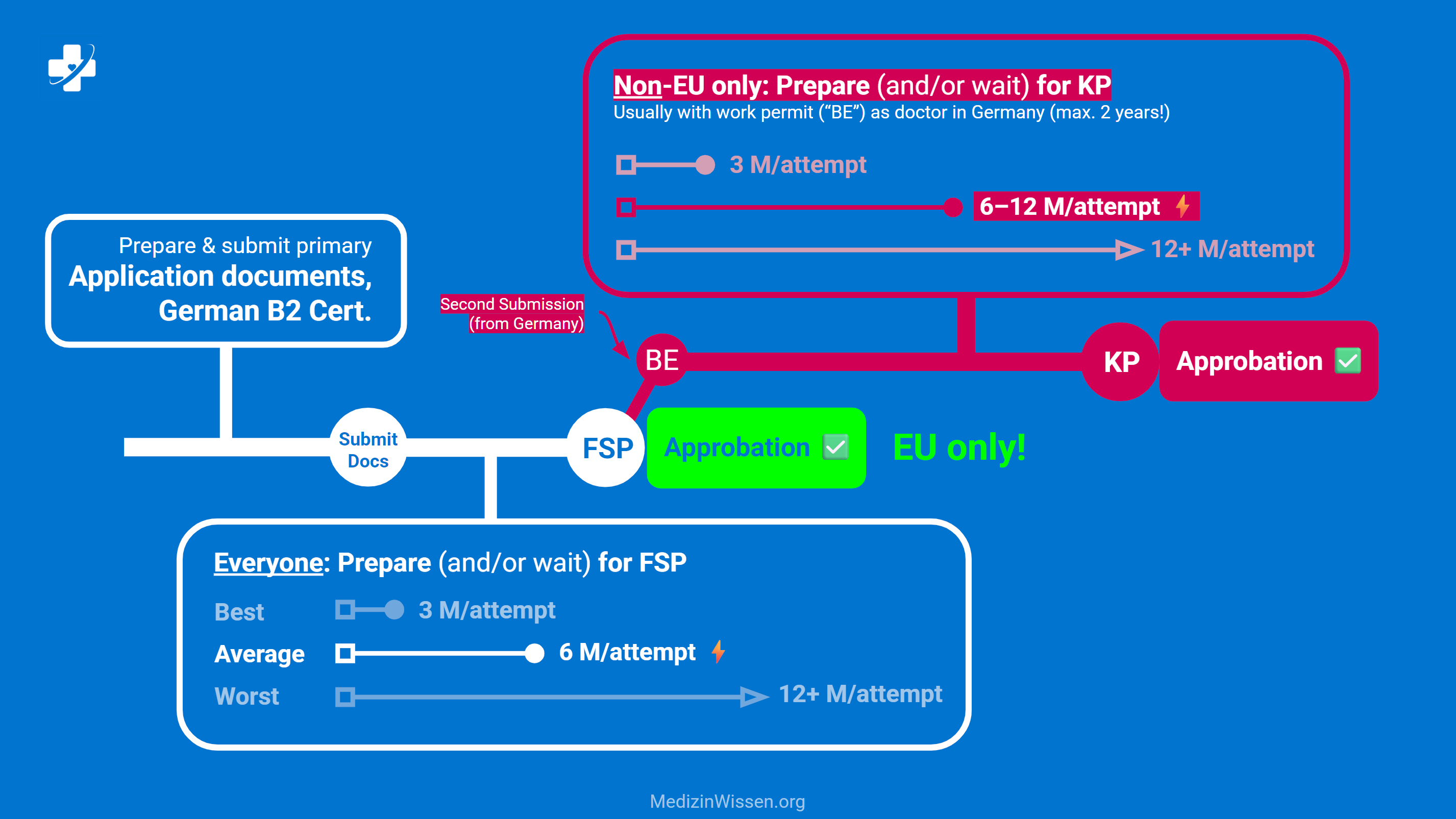
You apply to the competent authority in the federal state where you intend to work. The details vary by Bundesland, but the practical questions are similar: where do you apply, which documents do you need, when do you prove language skills, and how do FSP, Berufserlaubnis, KP and Approbation fit together?
- 1Clarify your profileEU/EEA/Swiss qualifications often follow a different route from third-country qualifications. Your country of training, documents and professional status matter.
- 2Choose the federal state carefullyGermany does not have one single Approbation authority. You usually apply where you intend to work, and you should not start parallel applications in several states.
- 3Organize your documentsTypical categories include identity documents, degree certificates, transcripts, professional registration, good standing, CV, translations and certified copies.
- 4Prepare German and FSPMost applicants need general German around B2 and medical German at C1 level, usually demonstrated through the Fachsprachenprüfung.
- 5Use Berufserlaubnis only as a limited bridgeA Berufserlaubnis can allow restricted work under supervision, but it is not the same as full Approbation and usually remains limited by time, place and scope.
- 6Plan KP and ApprobationThe KP is a clinical-practical knowledge test. For many third-country doctors it is becoming the central route toward full Approbation.
FSP, KP and GWP
Three abbreviations decide most of the practical planning.
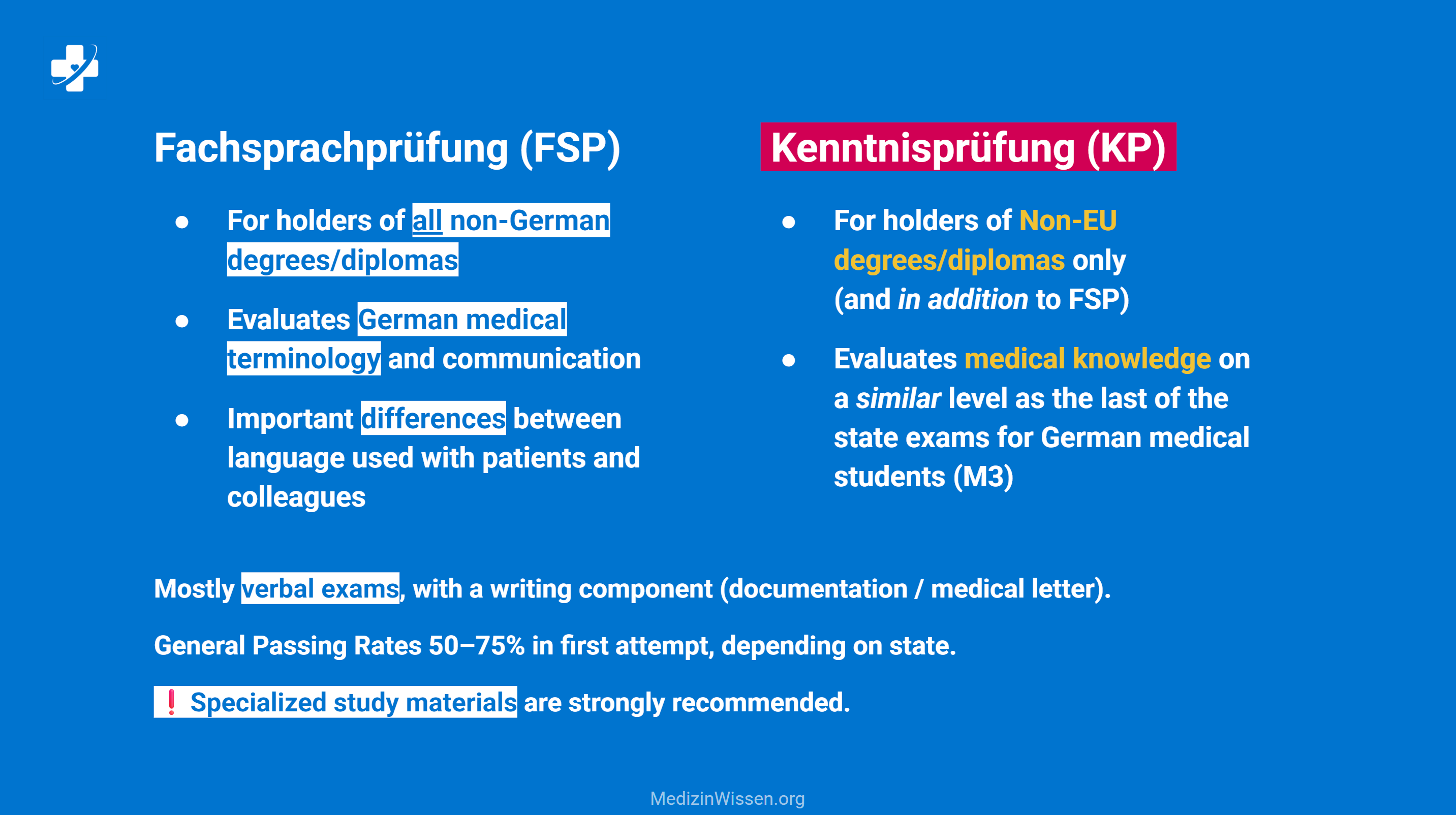
FSP checks medical communication. KP checks whether your clinical knowledge and reasoning meet the German standard. GWP is the document-based equivalence assessment. After the 2026 reform direction, third-country doctors should plan realistically for KP instead of relying on a pure document route.
FSP: medical language
The Fachsprachenprüfung tests history taking, patient-friendly explanations, documentation and doctor-to-doctor communication. It is about safe clinical communication, not only grammar.
KP: clinical-practical knowledge
The Kenntnisprüfung usually focuses strongly on Internal Medicine and Surgery, with additional areas such as emergency medicine, pharmacology, radiology and legal/professional basics.
GWP: document comparison
The Gleichwertigkeitsprüfung compares your foreign training with German medical training. It can still matter, but for many third-country doctors it should no longer be the only plan.
Documents, costs and timing
The hidden cost is often not the exam fee. It is lost time.
Official requirements vary, but applicants often need translations, certified copies, certificates of good standing, proof of training, CV, language certificates, health and personal-suitability documents, and proof that they intend to work in the responsible federal state.
Start from a status checklist
Before uploading sensitive documents anywhere, create a simple status overview: available, missing, translated, certified, submitted, unclear. This makes the next action visible without over-sharing personal data.
Prepare from abroad when possible
Many delays can be reduced before moving: language preparation, FSP structure, KP orientation, document collection and choosing the right state strategy can start early.
What MedizinWissen offers
Support for the path before, during and after your recognition process.
MedizinWissen.org has supported international doctors for years with preparation for medical German, FSP, KP and oral-practical exam situations. The Doctors Abroad project adds a clearer pre-arrival and process-orientation layer for doctors planning Germany.
FSP preparation
Structured medical German preparation for history taking, patient explanations, documentation and case presentation. Start here if medical communication is your main bottleneck.
KP preparation
Clinical reasoning and oral-practical preparation for the Kenntnisprüfung, including the typical focus on Internal Medicine, Surgery and related clinical topics.
Audio MindMaps and Lernpläne
Mobile, structured learning resources for high-yield medical topics, useful when you need orientation, repetition and prioritization during a long process.
Individual training
Personal live support with Matthias Behrends for difficult FSP, KP, clinical communication or oral exam situations where targeted feedback matters.
Process readiness check
Planned service: a practical review of your process status, missing information, next steps and preparation strategy. It will not be legal advice or authority representation.
Doctors Abroad community
Coming soon: English weekly updates for international doctors about recognition, documents, FSP, KP, reform changes and practical planning.
Doctors Abroad community
The English community is coming soon.
Doctors Abroad will become the English update layer for international doctors who want to work in Germany. The focus will be practical: reform updates, Approbation planning, FSP and KP preparation, document timing and common mistakes.
Important boundary
Practical orientation, not legal advice.
The information on this page is for general orientation and educational purposes only. It does not constitute legal advice, immigration advice, representation before authorities, or a guarantee of recognition, Approbation, Berufserlaubnis, FSP or KP success.
For binding information, contact the competent German authority directly or consult a qualified lawyer. The competent authority alone decides which documents are required and whether your application is complete.